
The Future is Flowers
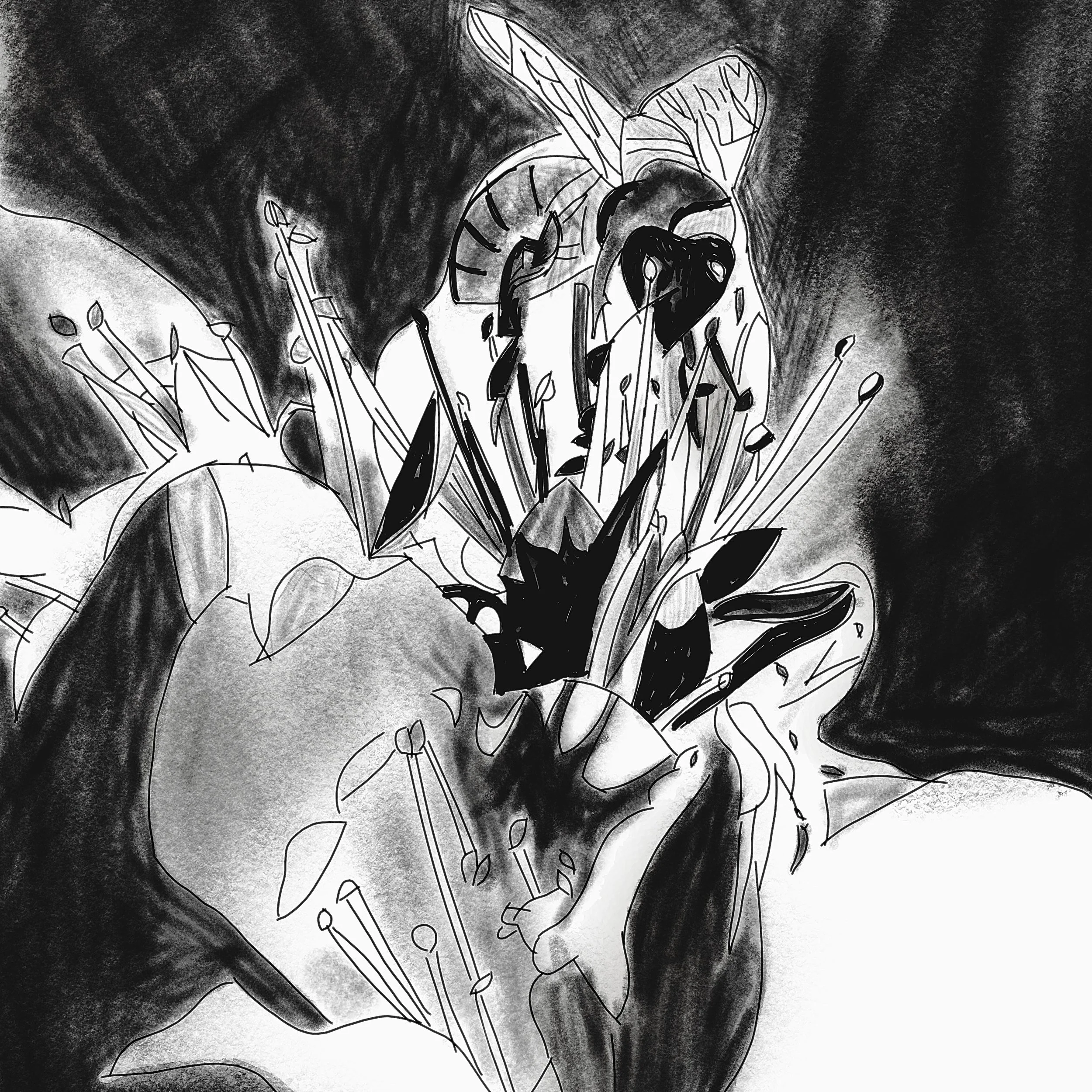
There is a particular kind of attention that beekeeping demands. Not patience, exactly. Something more like devotion. I keep honeybees for ecological and agricultural reasons, as an ongoing design experiment, a form of iterative thinking that happens to involve living creatures. They are exquisite and precise, and I have come to understand them as colleagues.
Last week I watched National Geographic's The Secret of the Bees, and it confirmed what I've long suspected: honeybees have major main character energy. The docuseries is a genuine paradigm shift, its extreme macro cinematography collapsing the distance between their world and ours. Something tiny becomes monumental. The familiar becomes alien, then luminous.
What the camera reveals is already well-documented in science but rarely felt in the gut: honeybees have engineered the optimal structure. Hexagonal cells minimize material usage while maximizing strength and minimizing weight, an architectural solution so efficient that human engineers still study it. The cells are built from wax, a byproduct of the bees' diet of nectar and pollen, emerging as scales on their abdomens. The bees scrape these scales with stiff hairs on their hind legs, transfer them to their mouths, and chew, mixing wax with enzymes and saliva until it becomes something entirely new. Honeybees are alchemists. They are always chewing things and changing them.
I've had successes and "failures" with my own hives, though I use that word with deliberate suspicion. This past winter, a brutal cold snap burst a major pipe in my old Victorian house in the Hudson Valley. I felt the threat to my bees viscerally, intuitively, as one does when responsible for living things. They survived. I was astonished and delighted.
The word failure deserves the quotation marks. It is wickedly wrong in most contexts, implying a broken process, a finality, a verdict. In the scientific method, failure is neither final nor broken. It is the essential, productive mechanism through which knowledge is generated. Our mettle is not tested in prosperous times; it is revealed in how we handle misfortune, what we learn from difficulty, how quickly we return to the work. Failure is feedback. You note the observed results, and you apply them to the next experiment.
Watching bees navigate the immense architecture of flowers, landing with precision on structures that, from their vantage point, rival any cathedral, made the monolithic geometry of human construction feel suddenly blunt. The comparison brought me back to Bilbao, summer of 1999.
I had received the Gertrude A. Wood Traveling Fellowship from the Yale School of Architecture and used it to move through the world with intention. I wanted to know buildings in my body, so I went to Notre Dame in Paris, Angkor Wat in Cambodia, the newly completed Guggenheim Bilbao by Frank Gehry, and the Jewish Museum in Berlin by Daniel Libeskind.
Bilbao stopped me. The titanium form, blooming, iridescent, formally reckless, was framed by centuries of regimented European urbanism. Gehry had placed it with extraordinary precision, so that it became a terminal view down pedestrian corridors carved through the old industrial city. The famous fish gallery slipped beneath the Puente de la Salve like roots growing through infrastructure over time. It communicated something I had wanted to believe since I was young: that being different is not a liability. It is aspirational.
That was always my motivation to build, to create strangely beautiful places that might subliminally reassure a little girl that she was right to be singular.
Architecture is a balancing act between physics and behavior. Forces, pressures, currents, flows can be calculated, modeled, controlled. Human behavior is less cooperative, but there are ways of reading it, diagnostic instruments I bring to transformation projects where understanding how people move through change matters as much as understanding how air moves through a building.
There is a growing field, biophilic design or neuroarchitecture, built on the hypothesis that the designed environment can heal, or harm, the brain. Scientists are now producing the vocabulary I've long been reaching for. A static, unnatural environment is not neutral; it actively inhibits neuroplasticity. What we have built, monolithic, inert, sealed against nature, may be working against the very minds that inhabit it. It is well established that a walk in a forest is more restorative than a walk on a city block. The question is what to do with that knowledge at scale.
I spent 2025 experimenting with my own neuroplasticity, out of curiosity about my creativity, and out of necessity for my mental health. Over 52 weeks, I administered 24 at-home ketamine treatments, less interested in the immediate psychedelic dissociative experience than in what happened afterward: a reset of old, entrenched, dysfunctional habits. Like many significant things in my life, its curve of influence was an asymptote, very slow at first, then rapid and ongoing, ultimately manifesting in empathy, creativity, capacity, and vision.
The first time I injected ketamine, it gravely rattled me. I felt my soul leave my body as though I were in a casket. Since the ketamine had found me via an Instagram algorithm, I had expected something milder, more CBD than THC. At that small gateway dose, a k-hole hadn't occurred to me as a possibility. But I fell into one. A woman I didn't know in Kentucky, whose life looked nothing like mine, was zooming from the floor of her bathroom while her kids buzzed around outside. She reached through the internet and encouraged me to try again. I am susceptible to interpreting random acts of kindness as signs. I trusted her. My own butterfly effect activated. I re-engaged, tracked my growth in journals and artwork, and went on many more journeys. The possibility that this kind of neuroplastic reset could be triggered by the built world, that geometry itself might nurture rather than hinder brain processes, has become a conviction, though I am not the first to hold it. Researchers studying restorative environments, sensory immersion, and the neuroscience of awe have been circling the same territory from the scientific side. What the ketamine gave me was not the idea but the proof of concept, a firsthand experience of what it feels like when a rigid mental architecture dissolves and something more adaptive takes its place. If chemistry can do that to a brain, design might too. It has a name now: neurosustainability.
It is spring when I watch my bees. I draw and dissect flowers, plants, and roots, mining them for architectural strategies that might soften our built world. Seen from a bee's point of view, the earth is an entirely different planet, fractal, recursive, patterned at every scale. It recalls the Eames Powers of Ten films, distributed by IBM in 1977: the radical proposition that the world repeats similar structures across orders of magnitude, from the galactic to the cellular. Nearly fifty years later, The Secret of the Bees offers a similarly revelatory shift in perspective, a suggestion that we have profoundly misunderstood our planetary cohabitants and the organic infrastructure we share with them.
Flowers, seen this way, become fractal architecture. And once that scale shift takes hold, once you accept the wildflower as monumental, the hexagonal cell as a structural achievement, the hive as a city, the possibilities for our own built spaces begin to feel genuinely boundless.
With or without walls.