
The Architecture of People
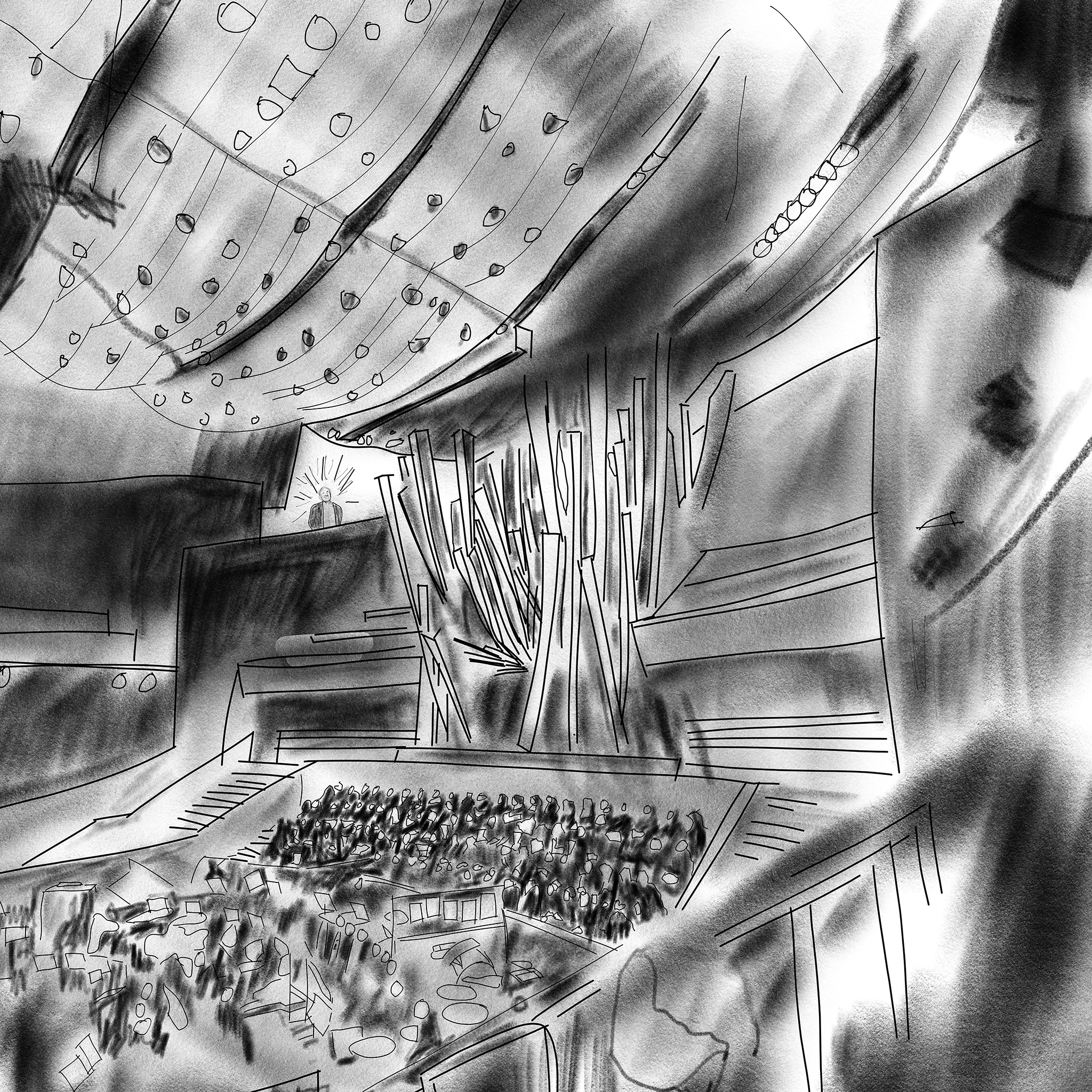
Inside Disney Concert Hall, there’s a place high above the stage where I kept looking for Frank. I knew he wouldn’t be there. And still, my eyes went to that spot. The absence felt oddly present, especially when the soprano voices soared high above the orchestra.
Last week in Los Angeles, I was surrounded by people who loved him and were loved by him. Colleagues. Collaborators. Fabricators. Old clients. Friends from different eras of his life, and mine. All gathered not just to remember the work, but to acknowledge what it meant to be changed by someone.
What moved me most wasn’t the scale of his buildings. It was the scale of his generosity.
Frank touched an extraordinary number of lives, quietly, directly, often without ceremony. He gave people chances. He tested them. He stayed loyal to the ones who believed in him early. He made room for people who didn’t fit the dominant modes of their time. That reach, across disciplines, hierarchies, and decades, feels like a worthy measure of a life.
Frank wasn’t a soloist. He was a conductor.
His work required enormous collaboration, and he understood how to bring unlikely groups into coherence, soldiers and rebels alike. Watching the musicians at Disney Hall, led with conviction and trust, I felt that parallel vividly.
Being there, I felt a dramatic shift from my own microcosm with Frank to his macrocosm—how many people he influenced, how many paths bent, subtly or radically, because of him. It was incredible to consider. It was inspiring to watch.
For a couple of hours at his memorial, we were all in his boat. Music like wind. Wooden panels above us billowing into sails. I could see him up there, conducting. Joyful. Cunning. Like he planned this all along.
Herbie Hancock talked about improvisation as a skill he and Frank shared. Esa-Pekka had angels singing from the rafters. Gustavo was regal, king of music, celebrating Frank, king of design. But they aren’t kings. They’re artists.
Frank found inspiration in all forms of creativity, all art forms. That openness, across mediums and across temperaments, is what gave his work its originality. He wasn’t just orchestrating extraordinary buildings. He was setting off catalysts.
I’m obsessed with the design of the invisible, the conditions that make the visible work. It doesn’t get enough attention, and it should. That room felt by design. The butterfly effect, realized. Earnest acts of generosity rippling through time, setting change in motion for generations.
With Frank, life is a paradox. A gruff comment could be a gift. A blunt critique could be a door opening. Frequently, two opposite things are true at once.
Which makes me think of the artist Cai Guo-Qiang. Pyrotechnics, gunpowder, and fireworks are at the center of many of his works. I’ve had a profound, and embarrassing, fear of loud noises for as long as I can remember, so Cai’s work resonated in a deeply personal way he wouldn’t have known.
In Spring 2009, my first day working for the Guggenheim, I was in Bilbao while Cai’s solo exhibition electrified the museum. His explosive works collided with Frank’s soft spaces. They transformed each other. A perfect friction. A dance between poets. That tension, between difference and between disciplines, was core to Frank’s intuition and values.
I visited Cai’s studio in the East Village around that time. He had a translator, but every so often he’d burst out with an emphatic English word or two. I was adjusting a Gehry model for him, dabbing hot glue onto a joint, flipping a can of compressed air upside down to blast it with cold and speed the cure. Cai watched me like it was a performance and declared, delighted, “Explosion!” It startled me back into the moment.
It reminded me that magic is everywhere, if you’re paying attention.
This year, as an antidote to my triggers, I’m paying closer attention to my glimmers. Everyday moments that are transcendent when you think differently.
Gustavo spoke about musicians who would be shaped by Disney Concert Hall, and Frank, for generations. As the voices soared and the conductors leaned into the orchestra, I could visualize the music as light, color ricocheting off the sculpted space. The conductor was playing the building by directing the orchestra. Frank was conducting the future by designing the space.
Through my social networks, full of Gehry and Guggenheim alumni, I’ve read countless tributes. Stories of opportunities Frank gave. Gifts he saw in people before they saw them themselves. His belief in the quirk. His celebration of difference.
That room, everyone in it had been touched by him.
If you could capture all those stories, overlapping, diverging, re-entering, you’d have more than a living archive. Different perspectives on a similar cast of characters. Endless iterations. Anecdotes. Legends. Each one feels like an independent film—a rich tapestry of nonfiction myth.
Frank wasn’t afraid of directness; he wanted lessons learned quickly.
Sitting beside the fabricator of the AGO bench, I realized how differently we each remembered the same process. We were both proud of the work.
Working with someone like Frank, every exchange can feel like an allegory.
Frank’s office was filled with architects from around the world, many working under “extraordinary ability” visas, insiders and outsiders, motivated to make the world better. They’ll go on to change things. To pass his torch forward.
That’s his masterful design legacy. Distributed. Unfinished. Still unfolding.